



Vitamin D back in the news - could 'The Sunshine Vitamin' prevent colds and flu?
“More than 3 million people across the UK could stave off infections such as colds or flu every year through taking Vitamin D supplements”, ran the headline of The Independent last Thursday. Indeed, vitamin D was dominating the headlines towards the end of last week across all media platforms, and not for the first time. And with 70% of the population suffering from at least one acute respiratory (such as a cold or flu) infection every year, could this latest claim be music to the ears of the UK population?
In this week’s article we take a closer look at the research and scientific mechanisms behind this latest research, as well as providing a recap on why vitamin D consumption is so important.
What is Vitamin D?
Vitamin D is known as ‘The Sunshine Vitamin’. This is because sunlight is necessary for the synthesis of vitamin D in the skin and those lacking in sunlight are at high risk of deficiency.
Vitamin D is not found in abundance naturally in foods. So simply put, not enough sunshine means not enough vitamin D, and hence issues with widespread deficiency in the UK particularly in areas such as parts of Scotland that get even less sunshine. The amount of sunlight (UV) in our winter months is insufficient and over the winter we need to draw on our bodily reserves.
There are some foods rich in vitamin D, primarily oily fish and eggs however fish consumption is poor in this country and as the Vitamin D Mission note:
“Salmon and other oily fish are big in vitamin D, along with liver, eggs and fortified cereals. But because of the quantities needed it’s hard to get enough from diet alone.”
Why is Vitamin D so important?
As noted on the Vitamin D Council website, “Vitamin D is important for good overall health and strong and healthy bones. It’s also an important factor in making sure your muscles, heart, lungs and brain work well and that your body can fight infection.”
Vitamin D has the following permitted health claims -
Vitamin D contributes to the:
- normal absorption/utilisation of calcium and phosphorus
- normal blood calcium levels
- maintenance of normal bones and teeth
- maintenance of normal muscle function
- normal function of the immune system
- process of cell division and
- vitamin D is needed for normal growth and development of bone in children
Certainly not for the first time, vitamin D has found itself right at the forefront of the media spotlight in the last week with new research from an NHS-backed study indicating that ‘daily vitamin D supplements would prevent more than three million people a year falling ill with a cold or similar infection’.
One of the researchers suggested that, "assuming a UK population of 65 million, and that 70% have at least one acute respiratory infection each year, then daily or weekly vitamin D supplements will mean 3.25 million fewer people would get at least one acute respiratory infection a year."
But what is the exact science behind this claim?
Immune mechanisms
Vitamin D influences both innate and adaptive immune systems. The action of vitamin D is based on its binding to the Vitamin D Receptor (VDR), a nuclear receptor, which influences gene transcription patterns and which is expressed in the majority of immune cells including monocytes, B cells, T cells, neutrophils and Antigen Presenting Cells (APCs ie dendritic cells and macrophages). APCs link the innate and adaptive immune systems and present antigens to T cells.
Vitamin D – Innate immunity
Macrophages and monocytes are cells that reside in every tissue of the body. They engulf dead cells and pathogens and produce immune effector molecules. Upon tissue damage or infection, monocytes are rapidly sent to the tissue, where they differentiate into tissue macrophages. Through their ability to clear pathogens and instruct other immune cells, these cells have a central role in the immune system.
As part of the innate response, Vitamin D binding to VDR induces the production of antimicrobial peptides (cathelicidins) that are capable of killing pathogens or binding to endotoxin. During viral infections the lung epithelial cells are capable of converting inactive vitamin D to its active form leading to increased cathelicidin production. Supplementation of vitamin D in those who are deficient has been found to improve cathelicidin production and protection against infection. Vitamin D also upregulates the level of autophagy by monocytes.
Thus research has suggested that the active metabolite of vitamin D “may enhance the antibacterial effects via enhancement of their [macrophages and monocytes] phagocytic and chemotaxis abilities”.
Vitamin D – Adaptive immunity
The adaptive immune system (or acquired immune system) responds slowly to an initial encounter with a pathogen but is able to create immunological memory so that subsequent responses are rapid. It includes T and B lymphocytes (white blood cells). Various types of T cells include those involved in killing the pathogen (T killer cells), regulating the immune response ie shutting it down once the threat has been neutralised (T regulatory cells), immunological memory cells (T memory cells) and others. B cells produce and secrete antibodies and also include a subset involved in immunological memory.
VDR expression increases significantly in activated B and T cells and influences 500 genes which are involved in the proliferation and differentiation of adaptive immunity cells. Importantly these genes also include ones that inhibit autoimmunity developing.
Vitamin D – Inflammatory response
An immune response upregulates inflammatory pathways including Nuclear Factor kappa B (NFkB). Vitamin D upregulates Inhibitor kappa B (IkB) which reduces NFkB signalling leading to a decrease in inflammatory cytokines. Thus as well as upregulating immunity vitamin D is important to suppress an ongoing inflammatory response.
Sources of Vitamin D
Vitamin D dietary sources include butter, eggs, oily fish and fortified foods – these sources provide only low levels of vitamin D – most is produced in the skin following sun exposure. In the UK, vitamin D can be synthesised in the skin between April and September, 10.00 am to 2.00 pm, on sunny days (i.e. without cloud cover). Production also depends on genetics, age, sunscreen, clothing, and skin colour. Although vitamin D cannot be synthesised during the winter at our latitude, it can be stored in the body. Levels are likely to be lowest around March.
With vitamin D supplementation now publicly being recommended, it is important to understand the difference between the most common forms of vitamin D, and which is the most suitable for supplementation.
Choosing the right form
Choosing the correct form of vitamin D to supplement with is just as important as supplementation itself, and although the new government guidelines now advise that everyone should take a vitamin D supplement, actual advice in this area has been lacking.
Vitamin D3 vs Vitamin D2
Vitamin D3 is the most bioavailable form of this nutrient and far preferable to Vitamin D2 to supplement with.
Vitamin D2 is also known as ergocalciferol and is commonly produced by plants in response to UV radiation. Some fortified foods contain vitamin D2 as an inexpensive addition, however it is not well absorbed or utilised by the body.
Vitamin D3 (also known as cholecalciferol) is the most bio effective and biologically active form of this nutrient and is found in humans and animals.
So when choosing a vitamin D supplement, you are looking for vitamin D3 and not vitamin D2. Where you wish to take a multivitamin and mineral that includes Vitamin D3 it is always important to select such a multi-formula with a nutrient content tailored for your age, gender, pre-existing medical conditions, or specifically for children where appropriate. If you are considering taking a vitamin D3 supplement and a multivitamin make sure that you assess the total combined dosage of the vitamin that you will be taking.
Relevant Cytoplan products
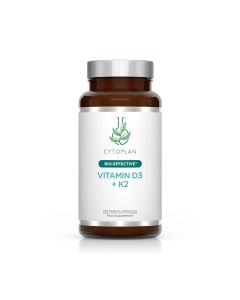
Our products contain vitamin D3, the most bioavailable form of this nutrient. Our vitamin D3 is from lichen and thus suitable for vegetarians and vegans
One tablet provides 62.5µg (2500i.u.) Vitamin D3 (Cholecalciferol) at 1250% of RDA. This can be taken alongside a multivitamin / mineral over the winter or all year round if needed
At a lower potency of 15µg (600i.u), this Wholefood vitamin D3 is suitable for children and perfect to be taken alongside a suitable multivitamin.
Our most comprehensive Wholefood Multivitamin and mineral formula. At a dose of 1 per day this includes 20 mcg (800 iu) vitamin D as well as antioxidant CoQ10, Beta Glucan for immune support, and good all round vitamin & mineral levels. This formula now includes additional phytonutrients and Acerola Cherry rich in vitamin C and carotenoids.
Ideal for vegetarians and vegans this vitamin D supplement comes in the form of vitamin D3 Drops. Two drops provide 5 mcg (400 iu).
If you have any questions regarding the health topics that have been raised please don’t hesitate to get in touch with me (Clare) via e-mail (clare@cytoplan.co.uk).
Cytoplan Editorial Team: Clare Daley and Joseph Forsyth.
References are available upon request.

We’d love your comments on this article
It’s easy, just post your questions, comments or feedback below