




Metabolism & Thyroid Function
Dr Alyssa Burns-Hill PhD is a leading holistic hormonal health specialist who has previously provided us with two fascinating articles on 'Thyroid Health' and 'Support for Disturbed Sleep'. This week she has been kind enough to supply us with another excerpt from her book "Weight Loss Winners and Dieting Downfalls", concerning the influence that thyroid function and metabolism can have on ones ability to lose weight.
As Alyssa highlights in her book, "Supporting your thyroid hormones is a major influence in your metabolism that will enhance many positive areas of your health and wellbeing. This can mean a huge difference in your success - both short and long term - in achieving your weight loss goals".
If you are struggling to lose weight there is likely to be a perfectly feasible explanation, and this article will you give an insight into what the source of the problem could be.
Alyssa begins todays article with a short questionnaire to help determine the current level of functionality of your metabolism.
Your Metabolism Do these problems apply to you? Sugar or salt craving - yes/no Cold body temperature - yes/no Loss of libido - yes/no Memory and thinking problems - yes/no Depression and/or anxiety - yes/no Low blood pressure - yes/no Dizziness - yes/no Allergies - yes/no Fatigue and loss of stamina - yes/no Aches and pains - yes/no Low blood sugar - yes/no Little or no weight loss - yes/no Constipation - yes/no Dry skin - yes/no Headaches - yes/no Unusual or prolonged fatigue - yes/no If you have answered yes to more than 3 of the above problems you are likely to be suffering from a slow metabolism that might be as a result of hormonal imbalance. Starting at the Beginning - Metabolism and Energy Metabolism is a term that is used to describe the breaking down of your food and drink (and other things ingested or absorbed by your body) as well as the making of bodily components such as peptides and proteins to maintain and repair your body. This process creates and expends energy at the cellular level. The speed of your metabolism, or metabolic rate, depends on the availability of thyroid hormones, not just the performance of your thyroid gland in pushing out an appropriate level of thyroid hormone, T4 (thyroxine). Low energy and tiredness go hand in hand with an inability to lose weight, this may be related to a slower metabolism, but you might also be on the 'Carb Yo-Yo Routine' and be complementing it with a few alcoholic drinks because you’re not sleeping very well. The Carb Yo-Yo Routine The Carb Yo-Yo Routine messes around with your blood sugar levels sending them up and down as well as helping to lay fat around the middle, changing your shape and raising your risk factors for heart disease and diabetes. If your sleep is disrupted because you’re running this boom bust energy machine and using alcohol as a way to relax your body and mind for sleep, you end up suppressing your insulin production and adding more confusion to your metabolic fire. Managing stress and regulating your food intake more effectively are so important to overcoming possible problems with metabolism and energy levels, but you still might be someone with thyroid hormone dysfunction. I see so many people that complain of weight gain without reason, or report the inability to lose weight on a diet, often blaming a slow metabolism. Some clients tell me that their doctor did a thyroid test that came back ‘normal’, whilst others just put it down to getting older. There are reasons why your thyroid hormone function may be causing a slowed metabolism even though your doctor is unable to identify it. Medicine doesn’t have all the answers because it may be more to do with the way in which thyroid hormones are functioning rather than what your doctor is looking for, which is a disease process. However, doctors who rely on TSH (Thyroid Stimulating Hormone) and fT4 (free Thyroxine) testing will not discover a thyroid hormone function problem and may perhaps offer SSRI antidepressants to help with the feelings of depression and anxiety that can often go with undetected thyroid hormone problems. Unfortunately these drugs are likely to contribute to weight management problems. The key is to address the thyroid hormone situation.
- Dieting Downfall - your stress hormone and energy regulation.
- Dieting Downfall - factors that can affect thyroid hormone function causing fatigue and lack of weight loss.
- Dieting Downfall - fatigue is a major reason why people are unable to make better food choices and opt for processed foods.
- Dieting Downfall - fatigue is a major reason why people cannot find willpower.
- Dieting Downfall - fatigue is a major reason why people opt out of exercise!
[caption id="attachment_2490" align="aligncenter" width="341"]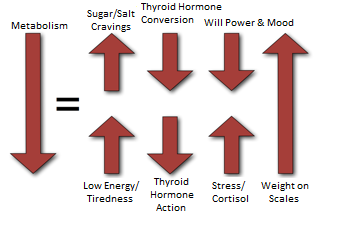 image © Dr Alyssa Burns-Hill[/caption]
Your metabolism can slow down, which can have effects that draw you deeper into weight gain hell. Problems with thyroid hormone conversion and action as well as stress, or the effects of cortisol, are significant for:
- Your metabolism slowing down, making weight loss an uphill battle.
- Your energy levels flagging, encouraging you to reach for sugar-based foods.
- Your mood to drop and with it your motivation.
- Your memory and ability to think properly may have you feeling that you can’t cope.
Thyroid Hormone Function
T4 is the main hormone secreted by the thyroid gland and this needs to be converted to T3 to be really useful in sending the thyroid hormone messages to your tissues, including your brain. The trouble is that thyroid hormone action can be interfered with by a number of saboteurs.
Here are the three possibilities:
1) Your T4 is not converting properly to T3
Your main thyroid hormones are T4 (Thyroxine) and T3 (Triiodothyronine) and chemically they are made up of L-Tyrosine (an amino acid) and 4 molecules of iodine, or, L-Tyrosine and 3 molecules of iodine if it’s T3.
T3 is by far the most active thyroid hormone– low levels will mean that you suffer with underactive thyroid problems without having an underactive thyroid condition.
(Interestingly, even people who have been diagnosed with an underactive thyroid and take synthetic Thyroxine (the usual prescribed replacement hormone) can have this problem, causing continual low thyroid symptoms that necessitate constant blood testing and tweaking of their prescription, often to no avail.)
High levels of cortisol (your stress hormone) will interfere with the conversion of T4 to T3. High cortisol will cause your T4 to convert to rT3 (reverse T3), which is a much weaker and therefore less effective hormone. Nutritional deficiencies can also affect the ability of your hormones to function properly here.
2) Stress and the hormone cortisol is impeding the function of your T3
High or low levels of cortisol in the blood stream caused by either:
On-going stress that is causing your adrenals to secrete a lot of cortisol or low levels of cortisol because your adrenals are now flagging and unable to keep up with demands. Both of these scenarios interfere with thyroid hormones ability to connect with tissue and it can be an on-going problem.
3) Hormone contraceptives lowering availability of your thyroid hormone
(if you have the book, the following is discussed in more depth the in next chapter) Higher levels of oestrogen will stimulate secretion of a protein called Thyroid Binding Globulin (TBG), which will bind to thyroid hormone, making it less available for your body to use.
What all this means is that you can be experiencing the effects of an underactive thyroid without having a diseased thyroid gland. I know that many of my clients feel a great sense of relief when they see their test results and have this scenario explained because they were convinced that something was going on with their thyroid but their doctor had insisted that it was normal.
So let’s have a look at what can be done to support your metabolism.
- Weight Loss Winner - Address nutritional deficiencies that affect thyroid hormones.
- Weight Loss Winner - Look at your stress factors.
- Weight Loss Winner - Look at hormone contraceptive use.
- Weight Loss Winner - Support mood and sleep.
[caption id="attachment_2491" align="aligncenter" width="430"]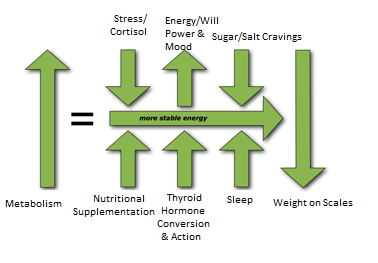 image © Dr Alyssa Burns-Hill[/caption]
There are some key nutritional deficiencies that can have an impact on your thyroid hormones and these deficiencies aren’t necessarily obvious, but they are likely to be quite common.
Nutritional deficiencies, particularly zinc and selenium, can mean that your body doesn’t have the necessary minerals to convert your T4 to T3.
Zinc is used in many enzymatic processes in the body and is important for;
- Supporting the immune system.
- Enhancing the actions of Vitamin D.
- Hormones – it’s an essential part.
- Balancing blood sugar and insulin.
- Formation of bone and skin.
- Converting thyroid hormone into its more active form (T3).
- Promoting thyroid activity.
- Caffeinated drinks like tea, coffee, colas etc.
- Steroid-based medication.
- Diuretics (if not prescribed for medical reasons they can be a favourite of dieters).
- The antibiotic tetracycline (or another group, fluoroquinolones) will interfere with absorption.
Don’t take any more than 25mg per day to support your body’s needs. The best forms of zinc for absorption are zinc citrate or zinc picolinate.
Selenium is another essential micro-mineral that is important for;
- Thyroid function.
- Immune system.
- Reducing toxicity from heavy metals.
- May help to prevent heart disease and cancer.
Stress and Cortisol
When it comes to optimal thyroid function stress and cortisol are very important influences (If you have the book please carefully review the preceding chapter on stress). However, if you are someone who takes Thyroxine be aware that general medical practice doesn’t tend to observe the importance of cortisol in thyroid function. It’s not uncommon for me to see test results of clients that illustrate how the prescription of thyroid medication has increased the processing of cortisol through the liver, putting more stress on the adrenals to replace it, which can lead to a further lowering of adrenal reserve so that there’s not enough cortisol in the blood for thyroid hormone to connect with its receptors. The outcome is that the individual has enough thyroid hormone but the hormone can’t connect to tissue in effective amounts.
The underactive thyroid symptoms continue, including problems with weight management. The influence of the Pill and HRT is another area that is not generally recognised with regard to thyroid hormone influence (this is addressed more fully in the next chapter on Oestrogen). If you are experiencing problems with weight management it may be because your contraception or HRT has slowed your metabolism and increased your ability to retain fluid. Supporting your thyroid hormones is a major influence in your metabolism that will enhance many positive areas of your health and wellbeing. This can mean a huge difference in your success - both short and long term - in achieving your weight loss goals.
Dr Alyssa Burns-Hill PhD is a leading holistic hormone health specialist with practices in Harley Street, London, Jersey in the Channel Islands and an international virtual clinic with patients all over the world. She is a fervent supporter of the charity Thyroid UK, being a Trustee and on their advisory panel, supporting their aims of promoting better thyroid health.
Alyssa has a background in health that stretches over 20 years – with an academic background in health promotion (MSc) and a PhD focused on ‘Holistic healing from breast cancer through the lens of hormones: Synopsis and synthesis’. More information about her and her book ‘Weight Loss Winners & Dieting Downfalls’ (including buying online) can be found by following the link below. The book provides a wealth of information including:
 “Learn key factors that can help you overcome your Dieting Downfalls and maximise your Weight Loss Winners with questionnaires to assess how you shape up in hormone health. This is not another diet book this information will make a difference whatever regime you choose to follow. If you want to know why, this book will provide you with hormone insights that impact men and women alike.”
Recognising the Connections: Stress, Thyroid Health & Function - 20th March, 10am - 5pm
If you have enjoyed this article, you will be please to know Alyssa will be holding a Thyroid Conference on the 20th March at Brockworth, Gloucestershire
With many thanks to Alyssa for this enlightening article. Alyssa has previously written blogs for us and you can find the links to those articles below. If you have any questions regarding the topics that have been raised, or any other health matters please do contact me (Amanda) by phone or email at any time. If you want to be alerted by email when a new post is published simply add your email address in the ‘Get The Latest Post By Email’ in the right-hand column.
Amanda Williams, Cytoplan Ltd
amanda@cytoplan.co.uk, 01684 310099
Relevant Links
Cytoplan Blog: Stress and Cortisol
Cytoplan Blog: Thyroid Problems – the difference between ‘form’ and ‘function’ - by Dr Alyssa Burns-Hill PhD
Cytoplan Blog: Support for disturbed or disrupted sleep - by Dr Alyssa Burns-Hill PhD

We’d love your comments on this article
It’s easy, just post your questions, comments or feedback below